Taaweel 2.0 Qurʾān research engine
Start researching

Features

Every feature, on a real screen.

Taaweel is a research engine for the Qurʾān. Here is how a question travels through it: each screen taken from the app, marked up, and explained in plain words.

13research stages
6,236verses counted
5tafsīr sources
6hadith collections
31classical dictionaries

For the ʿulamā

عَالِم الدِّين

Welcome, ʿulamā.

Taaweel is built to serve scholarship, never to stand in for it. Every claim is cited and every step is on the record, so you can check the work the way a scholar should.

  • Read the evidence behind every conclusion
  • Challenge a verdict and see what it rests on
  • Your details are read by a person and never listed or shared
For everyone

Welcome, everyone.

You do not need a degree to ask a careful question about the Qurʾān. Ask in plain language, follow the answer step by step, and open any source to see for yourself.

  • Plain-language summaries beside the evidence
  • Every run saved to your dashboard to come back to
  • Tokens and cost shown for every stage

Screen by screen

Eight screens, one method.

Each picture below is the real app, with the parts that matter marked. Enlarge any of them to see it in full.

Ask

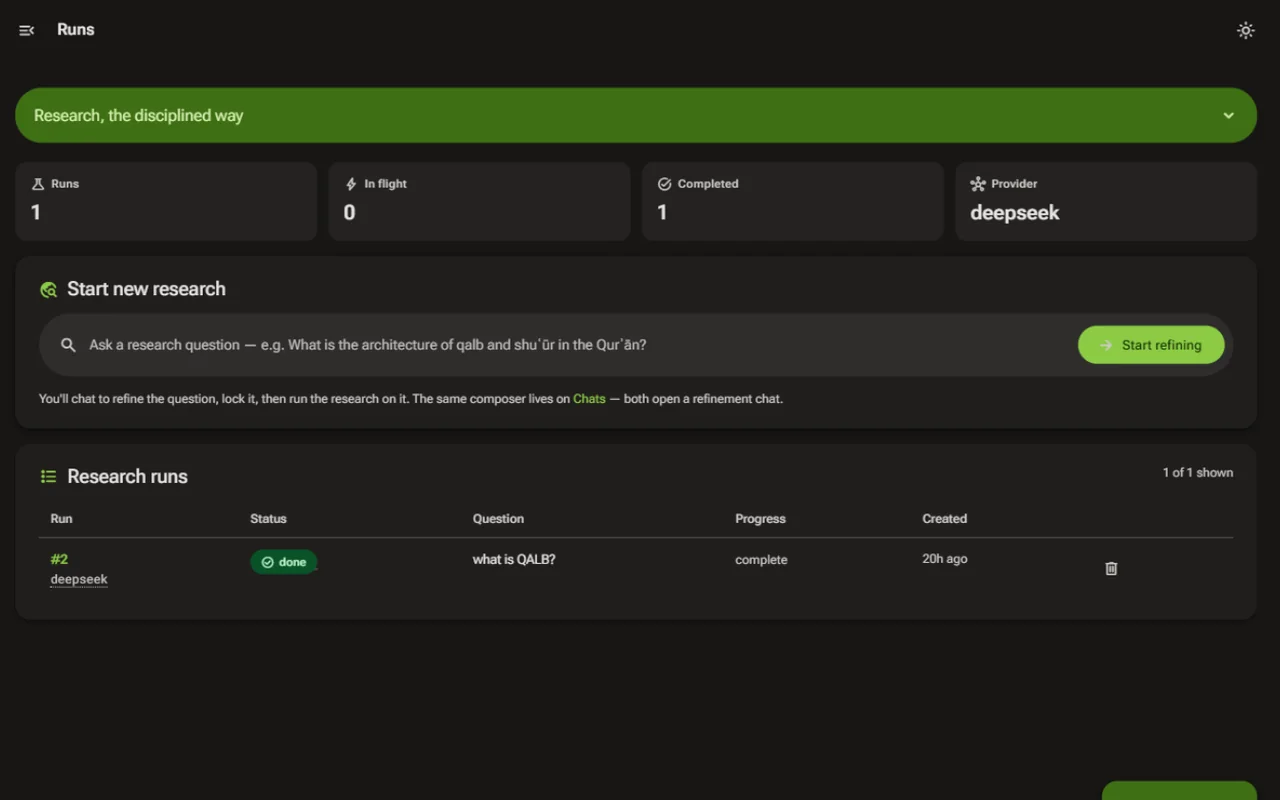
Runs dashboard

Ask a question, watch runs land, and keep every stage on the record.

Screenshot of the Taaweel runs dashboard with the research composer Stats for every run at a glanceAsk any research questionRefine it in chat before it runsEach run listed with its status
  • Stats for every run at a glance
  • Ask any research question
  • Refine it in chat before it runs
  • Each run listed with its status

On this screen

  • One composer: type any research question about the Qurʾān.
  • Refine the question in chat first, so the run starts from a sharp one.
  • Stats for all your runs sit at the top.
  • Every run is listed with its status, so nothing gets lost.

Why it matters

Research starts with a question, not a prompt trick. The dashboard is where you ask it, tighten it in conversation, and then watch the run come together. Every run you have started stays listed here, so you can return to it, compare it, or build on it.

Open Runs

Follow

A complete run

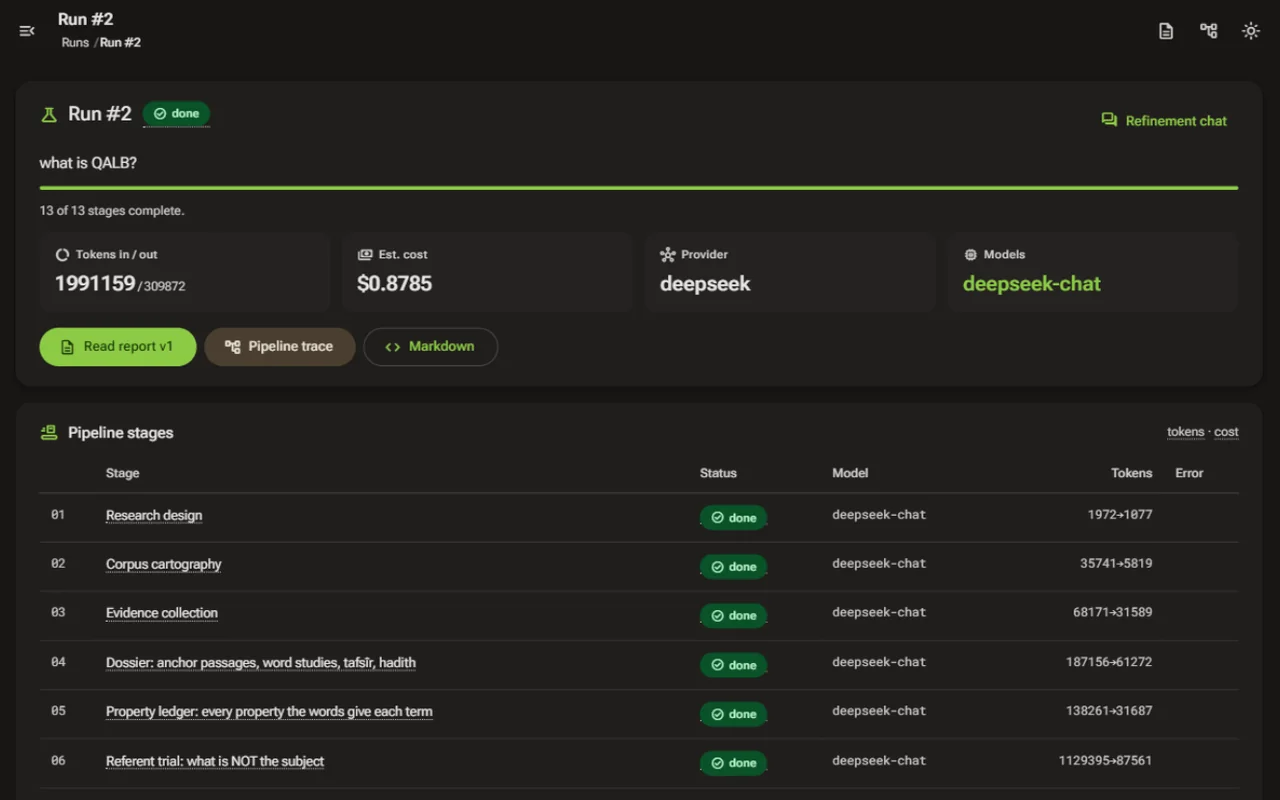
Thirteen stages from refinement to report - tokens, cost and status per stage.

Screenshot of a completed Taaweel run with thirteen stages done All 13 stages tracked to the endTokens and cost on the recordOpen the report or the full traceModel and tokens for each stage
  • All 13 stages tracked to the end
  • Tokens and cost on the record
  • Open the report or the full trace
  • Model and tokens for each stage

On this screen

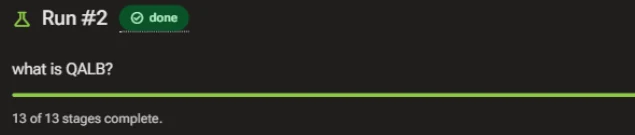
  • All 13 stages are tracked from refinement to the finished report.
  • Tokens and cost are recorded for every stage. Nothing is hidden.
  • The model and token count are shown for each stage.
  • Open the report or the full trace from the same page.

Why it matters

A run is not a black box that hands back an answer. Each of the thirteen stages reports what it did, which model did it and what it cost. You can open the report, or step into the trace, as soon as a stage finishes.

Browse your runs

Read

The cited report

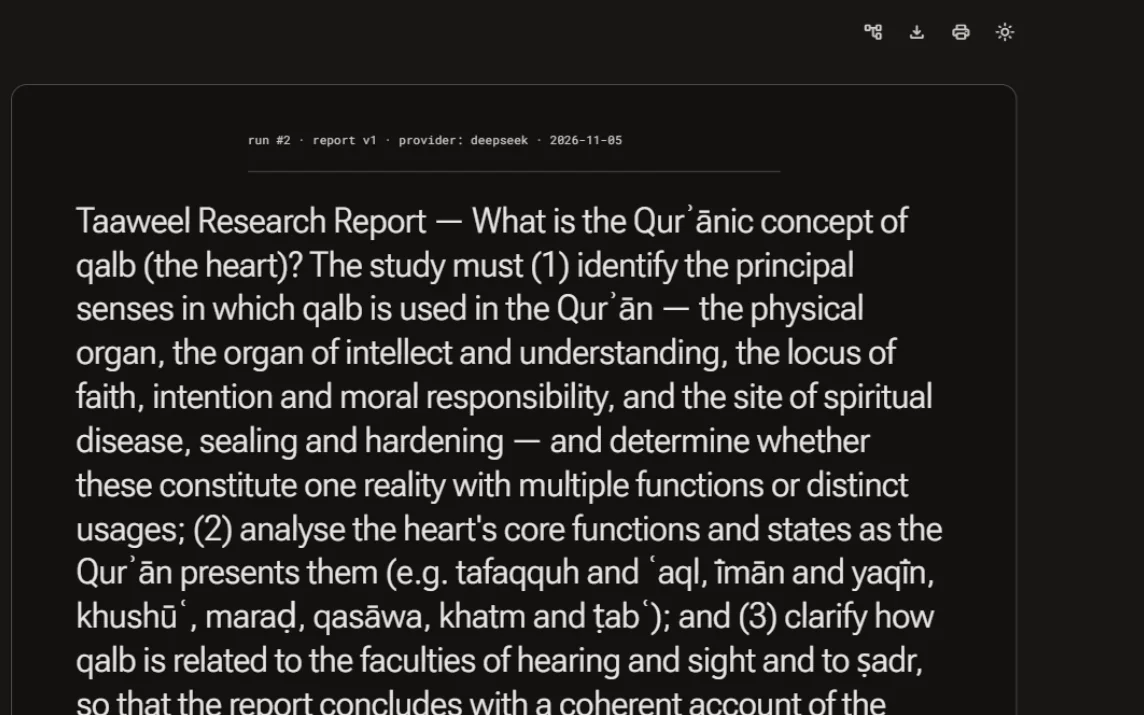
Answer first, then the argument - every claim pointing to a source you can open.

Screenshot of a cited Taaweel research report The research question, stated in fullExport, print or open the traceStamped with run, version and date
  • The research question, stated in full
  • Export, print or open the trace
  • Stamped with run, version and date

On this screen

  • The research question is stated in full at the top.
  • The answer comes first, then the argument behind it.
  • Every claim points to a source you can open.
  • Stamped with run, version and date. Export, print or open the trace.

Why it matters

The report is written for a reader who will check it. The conclusion comes first, the reasoning follows, and each claim carries a citation back to its evidence. The stamp lets anyone later see exactly which run and version produced it.

Open Reports

Count

The corpus it counted

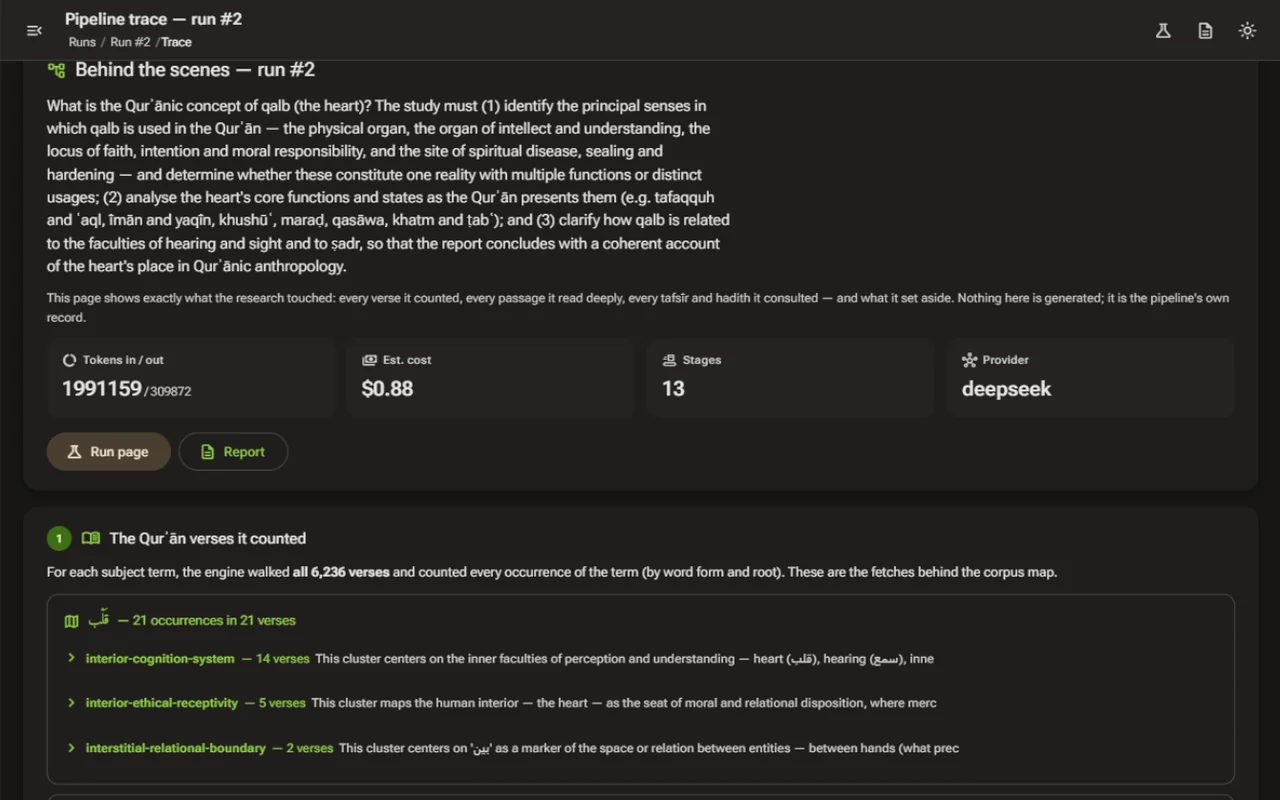
Every occurrence of a word, clustered by how it is actually used in the text.

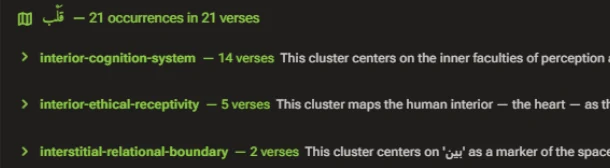
Screenshot of the verse clusters a Taaweel run counted Walks all 6,236 verses and counts each oneNothing generated: the pipeline's own recordStages, tokens and cost for the run
  • Walks all 6,236 verses and counts each one
  • Nothing generated: the pipeline's own record
  • Stages, tokens and cost for the run

On this screen

  • Walks all 6,236 verses and counts each one.
  • Every occurrence of a word, clustered by how the text actually uses it.
  • Nothing is generated here: this is the pipeline's own record.
  • Stages, tokens and cost for the run sit alongside.

Why it matters

Before any interpretation, the pipeline counts. It goes through the whole text, gathers every occurrence of the word under study and groups them by how the Qurʾān itself uses them. What you see is the record of that work, not a model's summary of it.

In every run's trace

Weigh

The evidence ledger

Five tiers, oldest to newest: verses, lexicons, tafsir, hadith - every row resolving to a citation you can open.

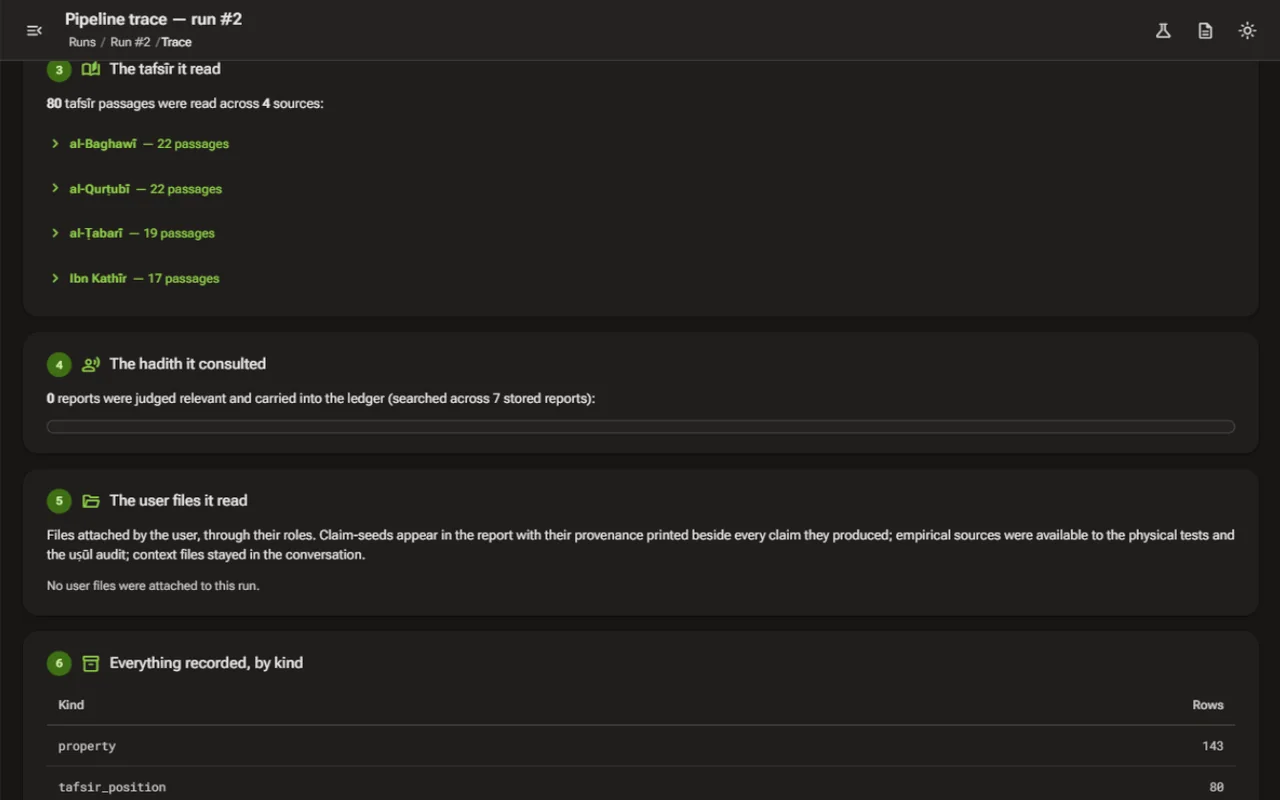
A Taaweel pipeline trace listing the tafsir passages read, the hadith consulted and everything recorded by kind 80 tafsir passages from 4 sourcesHadith weighed: 0 of 7 carried forwardEverything recorded, by kind
  • 80 tafsir passages from 4 sources
  • Hadith weighed: 0 of 7 carried forward
  • Everything recorded, by kind

On this screen

  • 80 tafsīr passages from 4 sources were read for this run.
  • Hadith are weighed one by one. Here, 0 of 7 were carried forward.
  • Evidence is kept in tiers, from the oldest sources to the newest.
  • Every row resolves to a citation you can open.

Why it matters

Interpretation is only as good as what it stands on. The ledger lists everything the run read and what it chose to use or leave out, including hadith it weighed and set aside. Nothing reaches the report without a row here to answer for it.

In every run's trace

Challenge

Critique, then audit

An AI agent argues against the conclusion first; the audit then checks it against the usul principles - in code, not on the model's word.

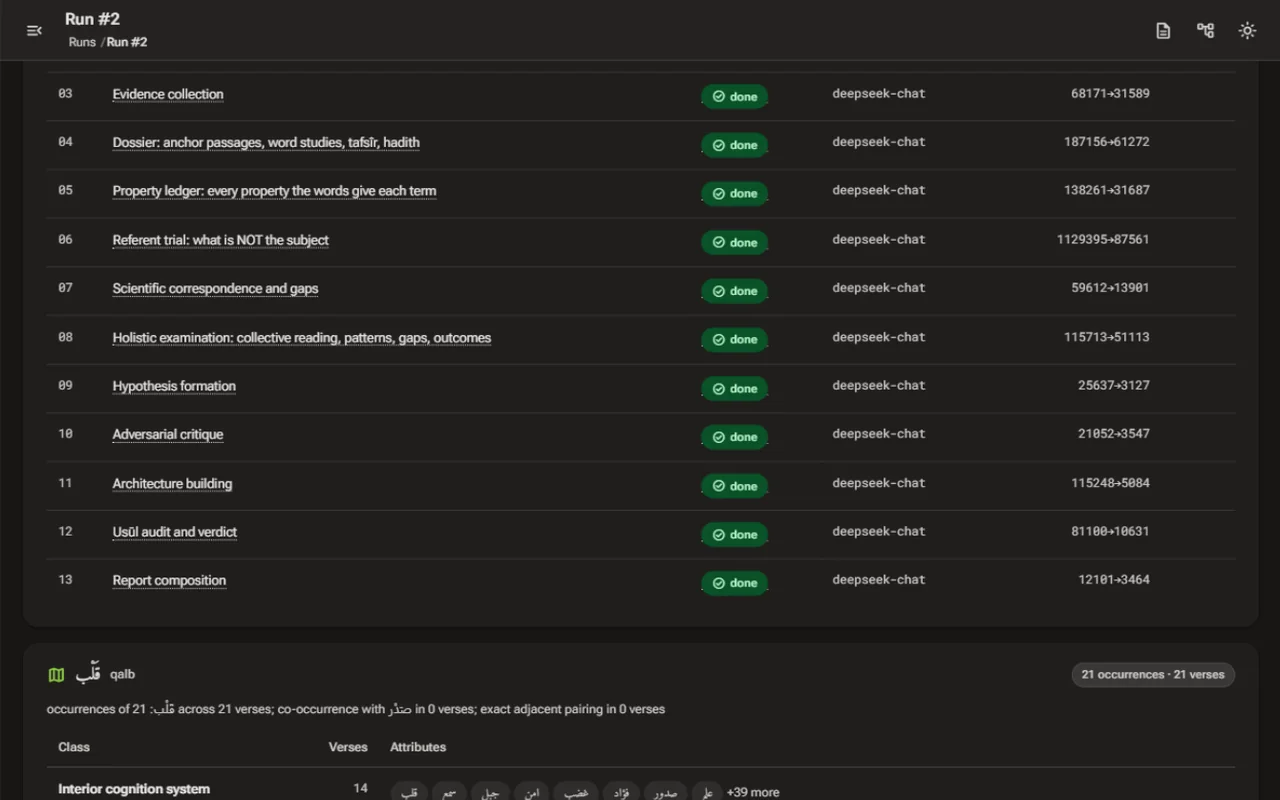
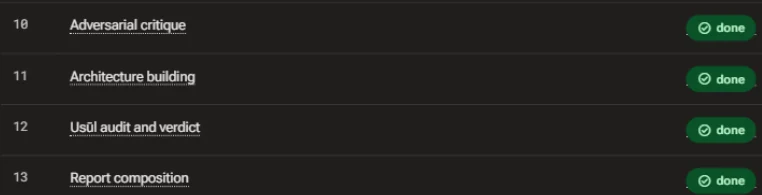
A Taaweel run showing its challenge and usul audit stages complete Stage 10: it argues against itselfStage 12: usul audit and verdictModel and tokens for every stage
  • Stage 10: it argues against itself
  • Stage 12: usul audit and verdict
  • Model and tokens for every stage

On this screen

  • Stage 10: an AI agent argues against the conclusion.
  • Stage 12: the uṣūl audit checks it against the principles and gives a verdict.
  • The audit runs in code, not on the model's word.
  • The model and tokens are shown for every stage.

Why it matters

A conclusion that has never been challenged has not earned much. Taaweel makes the system argue against itself first, then audits what is left against the uṣūl principles with ordinary code, so the verdict never rests on the model's say-so.

In every run's trace

Explore

The concept graph

Concepts and entities laid out as a graph, every link one click from its provenance.

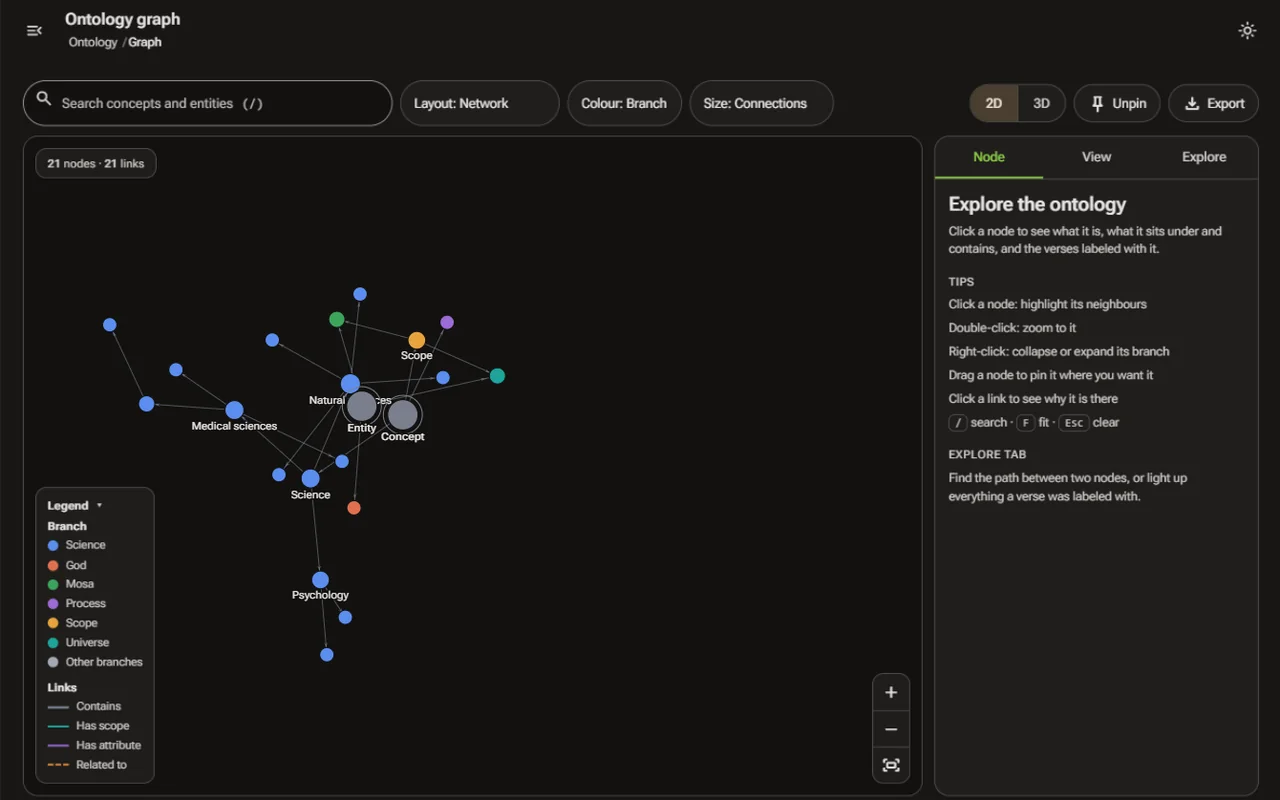
Screenshot of the Taaweel ontology graph explorer Concepts and entities, linked as a graphSwitch between 2D and 3DClick a node to see its verses
  • Concepts and entities, linked as a graph
  • Switch between 2D and 3D
  • Click a node to see its verses

On this screen

  • Concepts and entities are linked as a navigable graph.
  • Switch between a 2D and a 3D view.
  • Click any node to see its verses.
  • Every link is one click from where it came from.

Why it matters

The Qurʾān's ideas relate to one another, and a graph shows that better than a list can. Move through concepts, jump to the verses behind any node, and see where a link came from before you rely on it.

Open Ontology

Measure

Mizan

Numbers for any verse, surah or word - always with the counting rule that produced them.

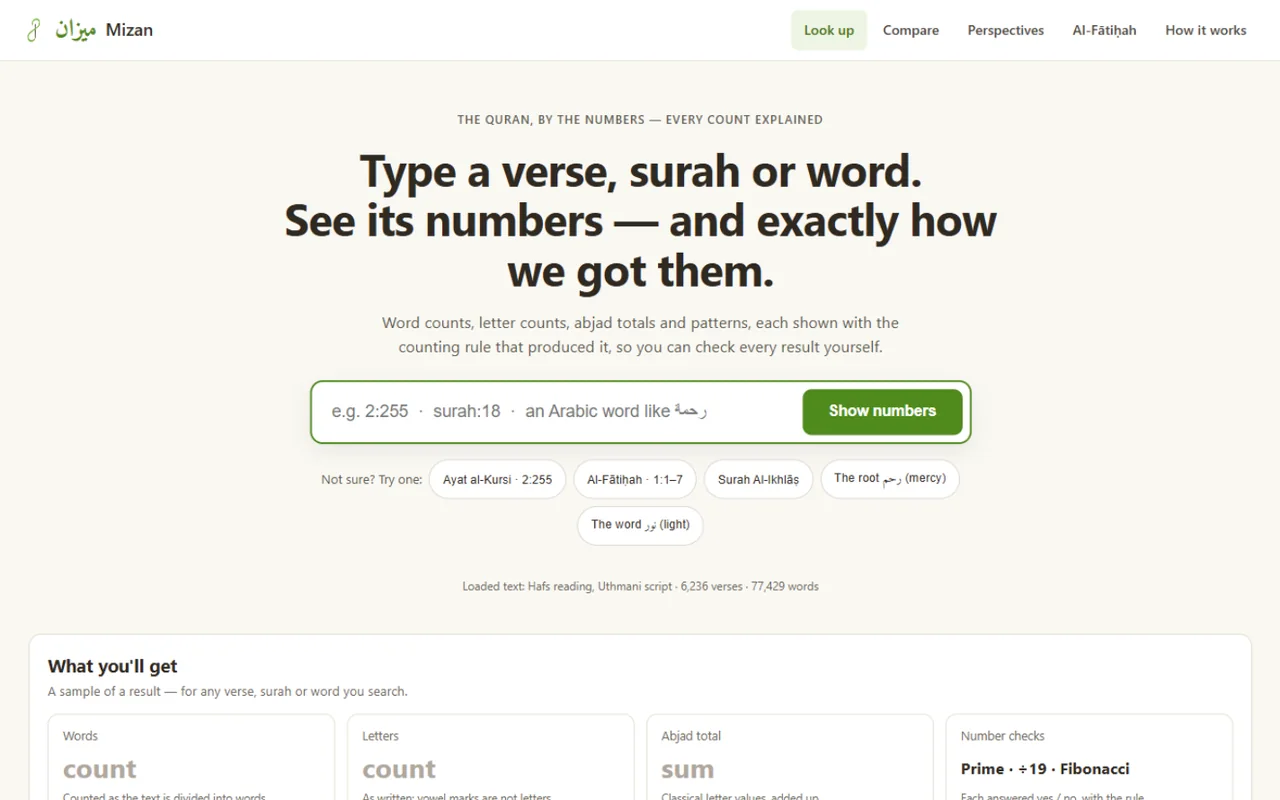
Screenshot of Mizan with numerical results for a verse Type a verse, surah or wordHafs text: 6,236 verses, 77,429 wordsOr start from a ready example
  • Type a verse, surah or word
  • Hafs text: 6,236 verses, 77,429 words
  • Or start from a ready example

On this screen

  • Type a verse, a surah or a word.
  • Counts follow the Ḥafṣ text: 6,236 verses and 77,429 words.
  • Start from a ready-made example if you are not sure where to begin.
  • Every number arrives with the counting rule that produced it.

Why it matters

Mizan is for anyone who wants to count honestly. Ask about a verse, a surah or a word and get numbers back together with the rule used to count them, so a figure can be checked rather than just believed.

Open Mizan

See it for yourself.

Bring a question. Leave with research you can defend, every step on the record and every claim carrying its own label.

These screens come from the owner's own research runs.